
The mechanism
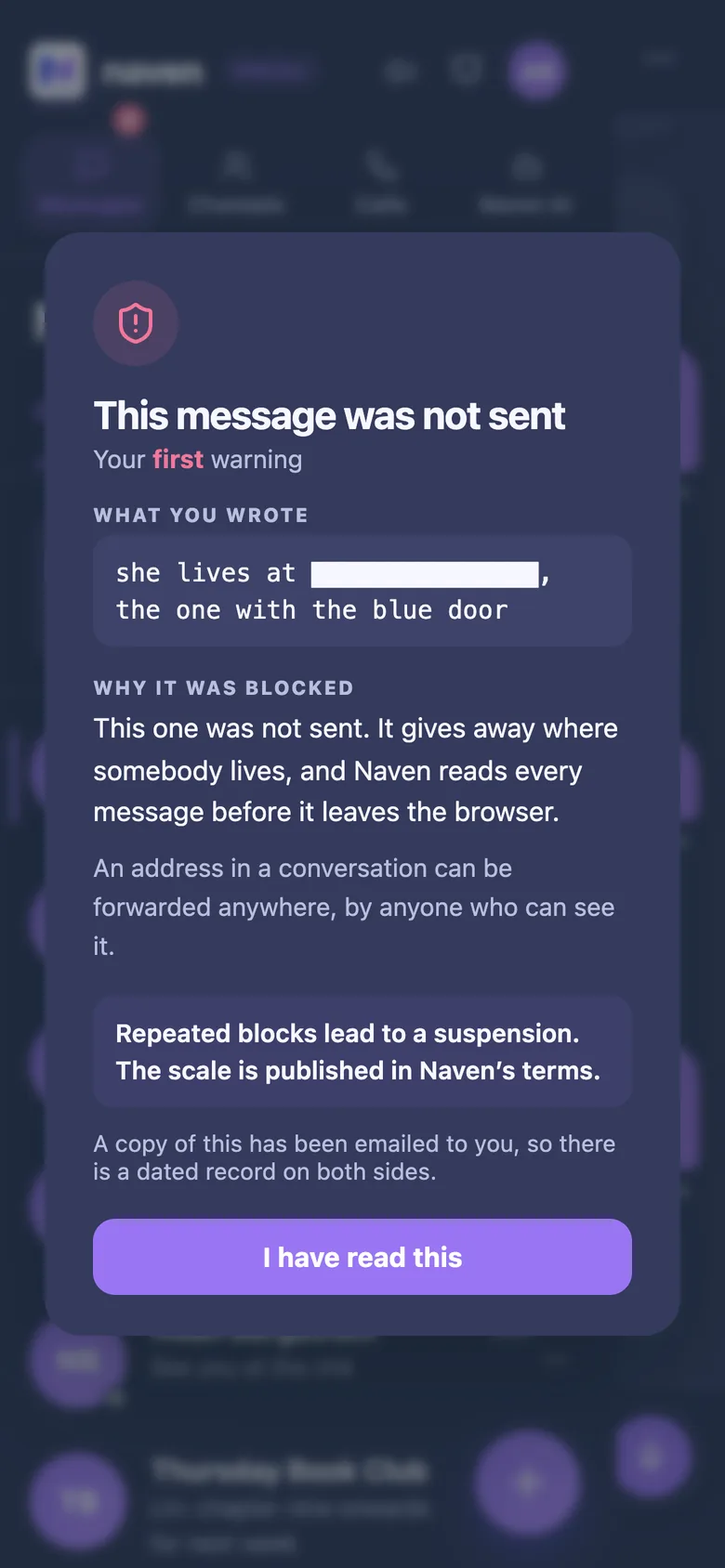
A message written in Naven goes to the server before it goes to the recipient. It is checked against 10 published categories: scams, malware, harassment, bullying, hate speech, sexual solicitation, illegal transactions, doxxing, encouraging self-harm, and graphic violence. If it matches, it is not delivered, and the person who wrote it is told which rule it met. If it does not, it is written to the conversation.
Three layers do that work in order: deterministic patterns, then a hosted safety classifier, then a general model asked the same ten questions in words. The patterns are the only layer that is fast and certain; the models are the only layers that understand a sentence. A refusal from a model is only honoured when the message itself corroborates it — a classifier that answers "privacy" because it saw the word email is reacting to a topic, not to an exposure.
A second review runs overnight with the surrounding conversation as context, and can retract a message after delivery. That is the layer that catches what a single message in isolation cannot show.
The trade, stated plainly
Screening before delivery requires the server to read the message. That is incompatible with end-to-end encryption, and Naven does not claim both. Anyone whose first requirement is that no server can ever read their messages should use Signal — it is the better product for that requirement, and saying so costs Naven nothing it should want to keep.
What it misses
The screen is automated software. It misses things, including obvious things. It is materially weaker in languages other than English, because the rule-based half is written in English. Calls are not screened at all. Insults, arguments and swearing are deliberately delivered — an app that will not carry a disagreement is not protecting anybody, it is editing a private conversation. Somebody saying they are struggling is never blocked; the message is delivered and help offered alongside it.
What the numbers actually look like
The screen runs on every message and almost never fires — refusals are rare, which is what it looks like when the rules match what people were going to do anyway. Naven does not publish how many people use it, or counts drawn from their accounts.
The newsroom, counted live from its database as this page is served: 1,676 briefings published so far, 1,641 of them in the last 30 days, across 21 news channels. A scheduled briefing runs only once at least five independent publishers have filed, and leads with a story at least two of them reported.
What the wait costs
The objection to screening before delivery is that it puts a classifier between a person and the send button. It does. Measured from a browser against the live service on 2026-09-13:
- 90 ms for a request that is answered before any check runs at all. That is the network round trip and the token check, and no design removes it.
- 112–202 ms for a sentence whose verdict has already been computed and is still cached.
- 485–935 ms for a sentence nothing has screened before. Three classifiers are asked at once; any refusal ends it immediately, and an “allowed” waits a further 250 ms in case one of the others disagrees.
So the honest figure is that a genuinely new sentence costs somewhere around half a second more than not screening it would. Two things spend that half second somewhere other than on the person waiting. The draft is screened while it is being typed, on a pause, so the send usually finds an answer already computed — which is what turns the second figure above into the common case rather than the third. And the message is drawn into the conversation the moment it is written, marked as sending until it lands, so the wait is visible rather than blank.
The part that is not free: text typed and then deleted can still reach the screen, because the rehearsal happens before anybody decides to send. Naven says so on its privacy page rather than in a footnote here.
Why publish the limits
Because the claim is only worth anything if the limits are attached to it. "Safe for every age" is a sentence a small messenger cannot keep, and a parent who reads it and later finds something that got through has been told something untrue by the product. A mechanism that can be checked — every message goes through the screen, here are the categories, here is what it misses — is the version that survives being tested.