 Naven
Naven
WhatsApp's own rule is that you must be at least 13 to use it on your own, or older where a country requires it. In March 2026 WhatsApp announced parent-managed accounts for children under 13, rolling out country by country, in which a parent decides who can contact the child and cannot read the messages, which stay end-to-end encrypted. Check WhatsApp's help pages for what is available where you live.
What teenagers usually dislike about WhatsApp is not the app but the groups: a year-group chat of two hundred people is two hundred people with your phone number, and anybody in it can save the number and message you directly. WhatsApp has a setting for who can add you to groups (Settings, Privacy, Groups), and it is worth changing whichever app you choose.
What parents usually dislike is that nothing can be seen or stopped. Harm on an end-to-end encrypted app is handled after somebody reports it, because the service cannot read a message before it arrives.
How the main options compare for a 13 to 17 year old
- WhatsApp: needs a phone number; end-to-end encrypted; 13 and over to use it alone; harmful messages are dealt with after a report.
- Signal: needs a phone number to register; end-to-end encrypted; built for privacy rather than for supervision.
- Telegram: needs a phone number; ordinary chats are not end-to-end encrypted (only its secret chats are); large public groups and channels are easy to find and join.
- iMessage: only between Apple devices; Apple can blur nude images for child accounts in Family Sharing.
- Snapchat: a parent who links through Family Center can see who their teen messaged in the last seven days, not what was said.
- Discord: 13 and over; Family Center shows a parent activity such as who their teen talks to, not the content.
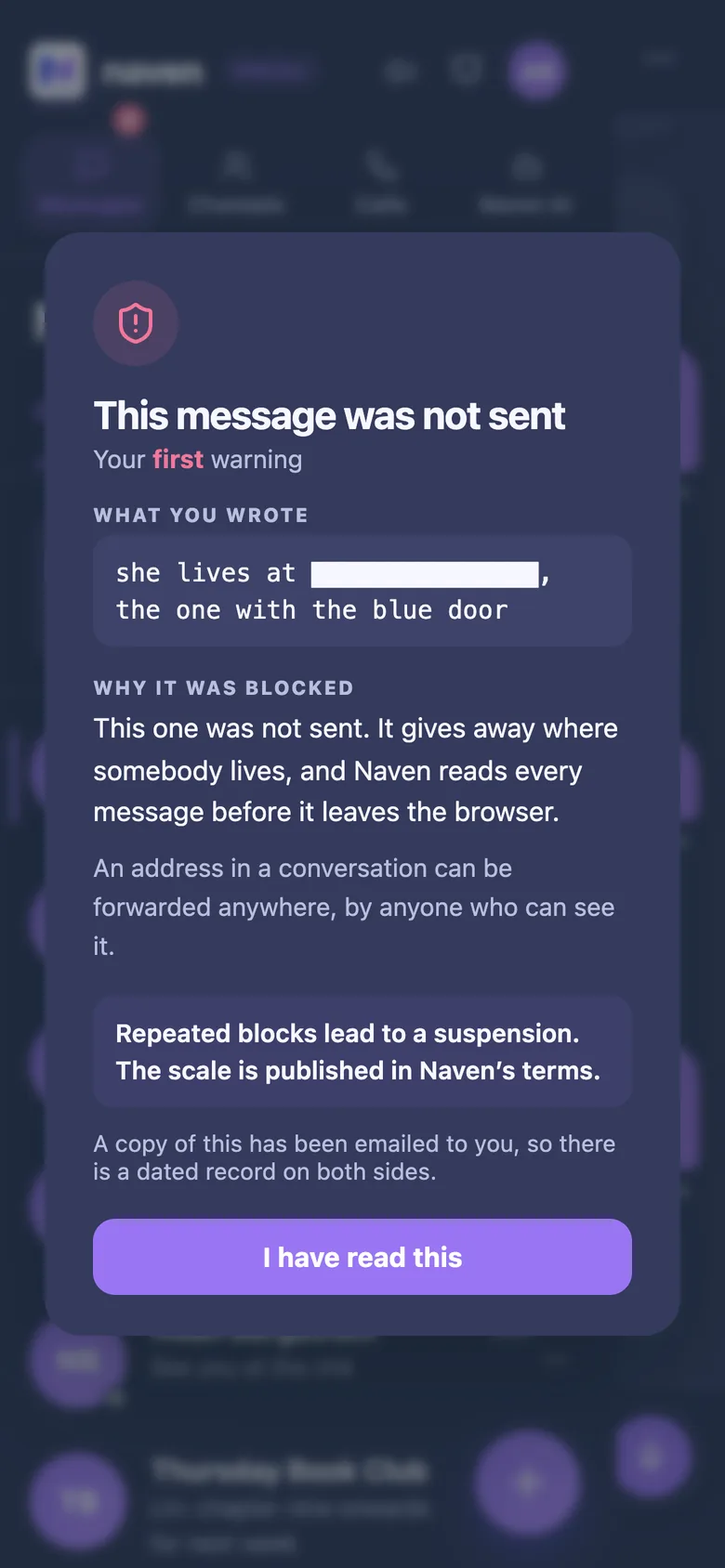
- Naven: no phone number; runs in a browser; not end-to-end encrypted, so every message can be screened before it is delivered; a parent agrees to the terms for a 13 to 17 year old and can see who they talk to and which safety categories were stopped, never what anybody wrote.
What a parent can see on Naven, and what they cannot
For an account aged 13 to 17, a parent or guardian agrees to Naven's terms, on the teen's device or from a link Naven emails them. The parent controls show who the teen talks to, when, how long they use Naven, and which safety categories were stopped. They never show what anybody wrote, or a contact's email address.
A teenager can block or report anybody from the conversation's menu without asking anybody, which matters: a teen who has to involve a parent to block someone often will not.
What Naven does not do
- It is not end-to-end encrypted. If that is the first requirement, use Signal.
- The screen is automated software. It misses things, and it is weaker in languages other than English.
- Calls are not screened at all.
- It is not a child-safety product, and it promises no safety, privacy or security; its terms say so.
Moving a group of friends without leaving WhatsApp
Nobody has to leave. Start one group on Naven, send its link into the WhatsApp group everybody is already in, and let people join when they open it. It opens in a browser, so there is nothing to install and no number to hand over. Keep WhatsApp for anybody who wants to stay.
More questions
Is WhatsApp allowed for 13-year-olds?
WhatsApp's terms let people use it on their own from 13, or older where a country requires it. Under 13, only through a parent-managed account, where WhatsApp offers them.
Can a 13-year-old use Naven?
Yes. For 13 to 17, a parent or guardian agrees to Naven's terms. Under 13, an account cannot send anything until a parent's consent is verified.
Can a teenager use Naven and WhatsApp at the same time?
Yes. Naven runs in a browser tab, so it sits alongside any app on the phone and needs nothing from it.