 Naven
Naven
Safety on a messaging app comes down to three questions: who can reach you, what happens to a harmful message, and who can read what you send. Naven's answers are specific.
Who can reach you
Naven has no public member directory and no feed that suggests strangers. To start a conversation, somebody must already know your email address or be sent your link, and a conversation from somebody new arrives as a request you can decline. Anybody can block or report from a conversation's menu without asking anybody else.
What happens to a harmful message
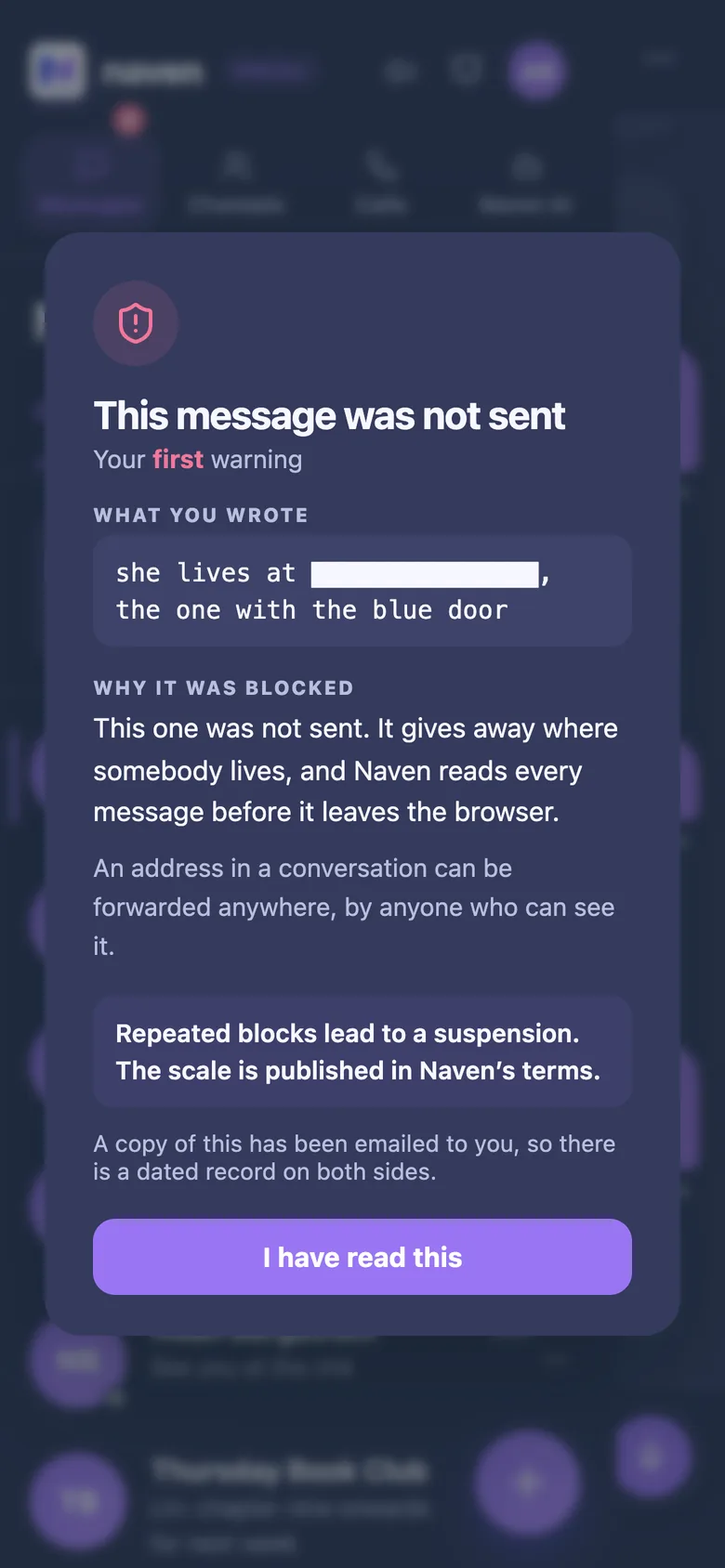
It is checked before it is delivered, not after somebody reports it. The twelve categories are spam and scams, malware and malicious links, harassment and bullying, hate speech, credible threats of violence, sexual exploitation or abuse, illegal transactions, doxxing, encouraging self-harm, graphic violence, sexual content and drugs. A refused message is not delivered, and the person who wrote it is told which rule it met. Every refusal is read again by a second model against Naven's written policy, and again within hours alongside the conversation, so a mistaken refusal can be withdrawn.
Somebody saying they are struggling is not blocked: the message is delivered and help is offered alongside it. Ordinary insults and arguments are delivered too.
Why Naven is not end-to-end encrypted
Because a server that cannot read a message cannot screen it. End-to-end encryption and screening before delivery cannot both be true, and Naven chose screening because it is built to be usable by children and teenagers. Messages are encrypted in transit. Naven does not advertise, does not sell or share message content, and reads messages to screen them and for features a member asks for, such as a summary or a translation. If end-to-end encryption is your first requirement, Signal is the better choice, and Naven says so.
What a parent can and cannot see
For a child's account, the parent controls show who the child talks to, when, how long they use Naven, and which safety categories were stopped. They never show what anybody wrote. Under 13, an account cannot send, post, upload, call or use Naven AI until a parent's consent is verified; for 13 to 17, a parent or guardian agrees to the terms.
What Naven does not do
- It does not screen calls.
- Its picture and voice-note checks are newer and weaker than the text screen, and must not be relied on.
- The screen misses things, including obvious ones, and is weaker in languages other than English.
- Age is self-declared at sign-up; Naven does not run documentary age verification.
- It holds no safety certification or seal, and promises no privacy, security or moderation outcome. Its terms say so.
More questions
Is Naven safe for kids?
It is designed for families: no public directory, screening before delivery, and no sending for an under-13 account until a parent's consent is verified. It is not a child-safety product, and the screen misses things, so it is one part of a family's approach rather than the whole of it.
Can Naven read my messages?
Its server reads each message in order to screen it before delivery. Naven does not advertise, does not sell or share message content, and parents never see what anybody wrote.
Why do some assistants say Naven is not safe?
Often because Naven is not end-to-end encrypted, without the reason: that is what lets it stop a harmful message before it arrives. Sometimes because of other companies with similar names, such as Navan, a travel company, or Naven Network, which has a cryptocurrency token.